What Can You Achieve in a 20-Lesson 1-on-1 English Course?
“How long will it take before I can actually speak English?” is the question almost every learner asks before signing up. At ICS English, each 1-on-1 English course has 20 lessons of 50 minutes. This guide explains exactly how those 20 lessons work, what you can realistically achieve, and how to get the most out of every session.

1. How much learning time is 20 one-to-one lessons?
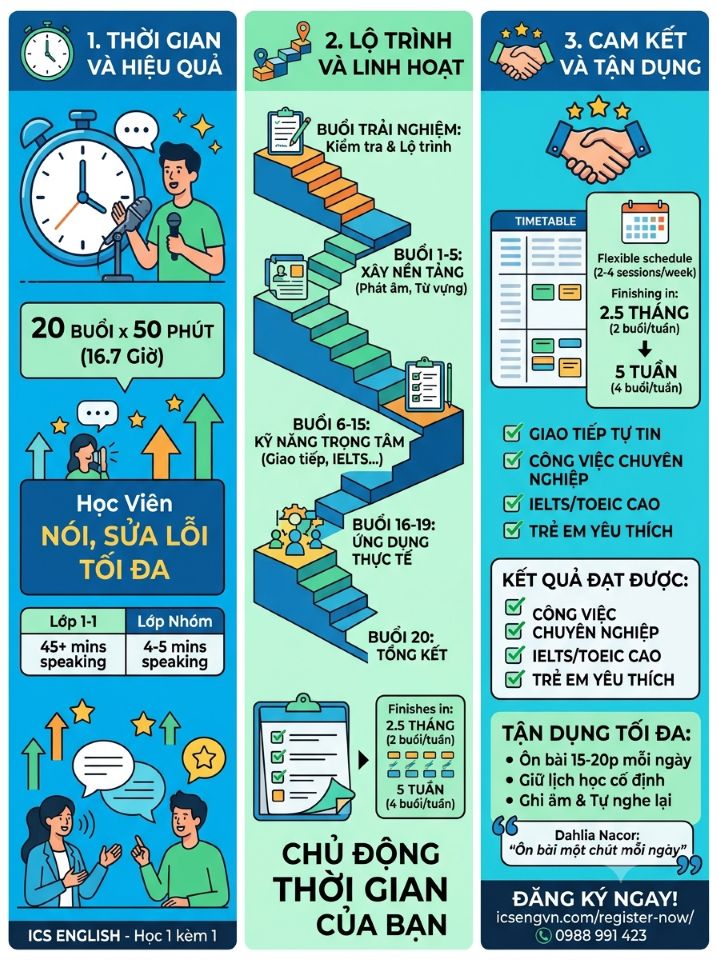
20 lessons × 50 minutes = about 16.7 hours with your teacher. That may sound like less than many group courses, but what matters is how much time you actually spend speaking and being corrected.
For example, in a 90-minute group class with 10 students, if half the time goes to student practice, each person speaks for only about 4 to 5 minutes. In a 1-on-1 lesson, almost the full 50 minutes is yours: you speak, your teacher listens, corrects you on the spot and adapts the lesson to your weak points.
2. How long does it take to finish 20 lessons?
You choose how many lessons per week, based on your schedule and goals:
| Lessons per week | Time to finish | Best for |
| 2 | About 10 weeks (2.5 months) | Busy professionals and school-age children |
| 3 | About 7 weeks | Learners with an exam or goal in the next few months |
| 4 | About 5 weeks | Anyone who needs fast progress before an interview, business trip or test |
Lessons are available from 8:00 to 23:00, so you can study before work, at lunchtime or in the evening.
3. How the 20 lessons are structured
Every learner gets a personal plan, but a course usually moves through these stages :
| Stage | What happens |
| Demo lesson (before the course) | Meet your teacher, get a level check, set goals and receive a suggested plan. |
| Lessons 1–5: Foundations | Get used to 1-on-1 learning and strengthen the pronunciation, vocabulary and core structures you’re weakest in. |
| Lessons 6–15: Core skills | Focus on what you need most: workplace English, IELTS Speaking, TOEIC Listening, kids’ English and more. |
| Lessons 16–19: Real-world practice | Practise real situations: meetings, presentations, interviews, mock tests, or themed activities for children. |
| Lesson 20: Review | Assess your progress, highlight strengths and areas to improve, and recommend next steps. |

4. What happens in a 50-minute lesson?
A typical lesson might look like this
| Part | Time | Activity |
| Warm-up | 5 min | Light conversation to get you speaking |
| Review | 5 min | Check the previous lesson and homework |
| New material | 15 min | New vocabulary, structures or skills |
| Practice | 20 min | Speaking, role-plays or exam tasks, with on-the-spot correction |
| Feedback and homework | 5 min | Summary of what to improve, plus homework |
5. What can you achieve after 20 lessons?
Results depend on your starting level, your goals and how much you practise between lessons. Here are typical goals for each programme
| Programme | Example goals after 20 lessons |
| Conversation English | More confidence in everyday conversations, smoother speech with fewer pauses. |
| Workplace and business English | Introduce yourself, give a short update in a meeting, and write clear work emails. |
| IELTS | Understand the test format, use effective strategies and improve your weakest skill. |
| TOEIC | Know every part of the test, apply strategies and build workplace vocabulary. |
| Kids’ English and Cambridge | Speak more confidently, learn topic vocabulary and get familiar with Cambridge task types. |
To be honest: 20 lessons bring clear progress, but raising your IELTS score by a full band or going from beginner to fluent usually takes a second or third course. Your teacher will give you straightforward advice based on your actual progress.
6. How to get the most out of 20 lessons
- Spend 15 to 20 minutes a day reviewing and doing homework.
- Keep a regular schedule and avoid rescheduling often.
- Tell your teacher your real goals from day one; the more specific, the better.
- Record yourself speaking and listen back to hear your progress.
- Bring real situations from your work or daily life into the lesson.
Phrases to set goals with your teacher
| I want to be able to lead a short meeting in English. | States a concrete, practical goal. |
| My goal is to get IELTS 6.5 by June. | Gives your teacher a target and a deadline. |
| Could we practice real situations from my job? | Makes lessons relevant to your daily work. |
| Please give me homework after each lesson. | Keeps you practising between lessons. |
| How am I progressing so far? | Invites honest feedback on your progress. |
| Tip from an ICS English teacher The fastest learners are the ones who review a little every day, not the ones who cram. |
Frequently asked questions
Are 20 lessons enough to speak English?
It depends on your starting level. If you already have the basics, 20 lessons will make you noticeably more confident and fluent. If you’re a beginner, the first 20 lessons build a solid foundation, and you may need another course to become fluent.
Can I finish faster than 2.5 months?
Yes. At 3 lessons a week you’ll finish in about 7 weeks; at 4 a week, in about 5 weeks.
Can I reschedule if something comes up?
How much does a 20-lesson course cost?
Fees depend on the programme (conversation, IELTS, TOEIC, kids’ English and more). Message us on WhatsApp for details.
What happens after 20 lessons?
You’ll receive a progress review and recommendations for next steps. You can continue with the same teacher in a new course to keep your momentum.
| Start your 20-lesson course • Book a 1-on-1 demo lesson (50 minutes): meet your teacher, get a level check and a personal plan. • Choose 2, 3 or 4 lessons a week, any time from 8:00 to 23:00. • Study online or at our Thu Dau Mot and Thao Dien branches. • WhatsApp: +84 988 991 423 | Register: icsengvn.com/register-now/ |
Related articles
- Filipino vs Native English Teachers: Which Is Right for You?
- Why 1-on-1 English lessons work faster than group classes
- How to choose an English tutor in Ho Chi Minh City and Binh Duong